Melbourne Day 2 started the way a good Melbourne morning probably should.
With a big breakfast in a laneway.
After spending our first day rediscovering Melbourne through Bourke Street, St Patrick’s Cathedral and Fitzroy Gardens, today we were heading in a completely different direction.
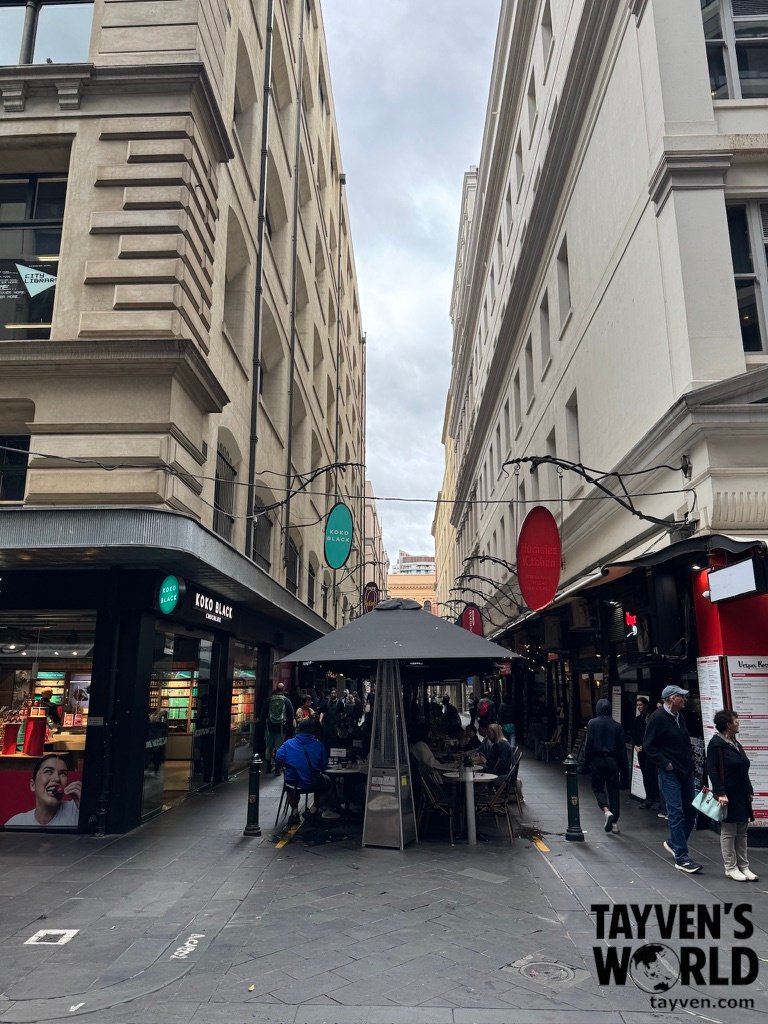
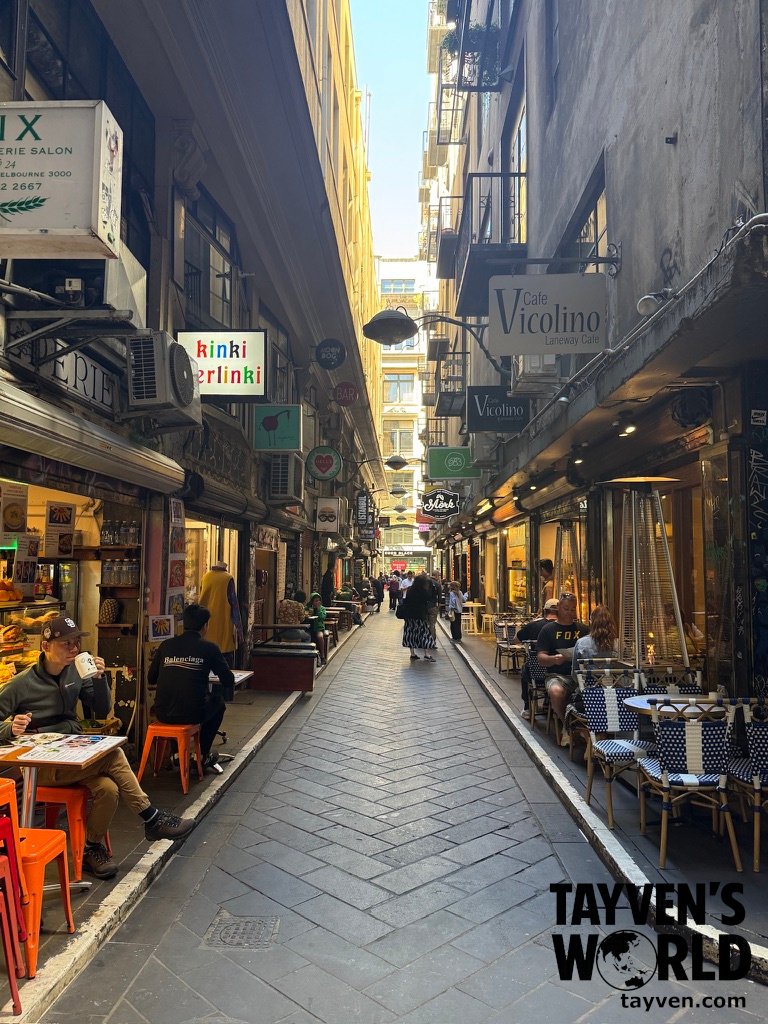
We walked across the city towards Degraves Street and Centre Place, two of those narrow Melbourne laneways that feel cozy and slightly chaotic at the same time.
Degraves Street & Centre Place
Degraves Street was already alive for the morning. Café tables ran down the middle beneath umbrellas, packed closely enough together that choosing somewhere for breakfast meant squeezing yourself into the seat.
I decided this wasn’t the morning for a light breakfast. I went for the big one: bacon, poached eggs, sausages, tomatoes, mushrooms and toast with BBQ sauce, washed down with a large cappuccino. It was fantastic, and considering how much walking we had planned for the day, I was more than happy with my decision.
Centre Place has an even tighter feel. Cafés, tiny shops and signs seem to stick out into the narrow laneway from every direction. It’s rustic and busy and works perfectly. It feels very Melbourne. We tried a few different cafés around these laneways during our stay and honestly didn’t have a bad breakfast. Breakfast finished, we crossed towards one of the city’s most recognisable buildings to do something generations of Melburnians had done before us.
We were going to meet under the clocks.
Meet Me Under the Clocks
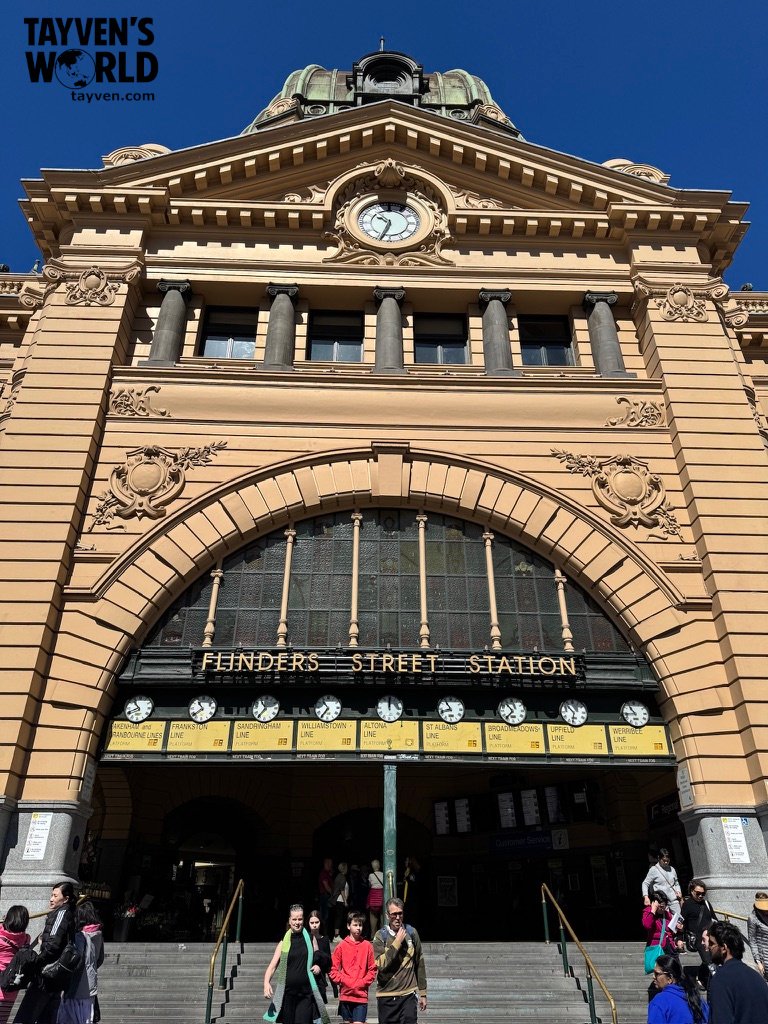
Long before mobile phones made meeting someone as simple as sending your location, the clocks above Flinders Street Station became one of Melbourne’s traditional meeting places.
“Meet me under the clocks” became part of the city’s language, and people still do it today. Naturally, we had to get the photo. The history of the site stretches back to 1854, when Australia’s first steam-hauled passenger railway began operating between Melbourne and Sandridge, now Port Melbourne. The magnificent station building everyone recognises today came later and was completed in 1910.
It’s one of those buildings that seems inseparable from Melbourne itself. The grand façade, distinctive dome, famous clocks, trams rattling past outside and the constant flow of commuters make it feel less like somewhere you visit and more like part of the machinery of Melbourne. We weren’t actually there to catch a train. Photos taken and Melbourne tradition completed, we kept walking.
Across the Yarra and Into Melbourne’s Parklands
After a quick look around Federation Square, we crossed Princes Bridge and headed towards the real destination for our morning. We were walking through the Domain Parklands towards King’s Domain and the Shrine of Remembrance. One thing Melbourne does remarkably well is green space.
Only a short time earlier we’d been squeezing between café tables in narrow laneways surrounded by buildings. Now we were wandering beneath trees along broad pathways surrounded by landscaped gardens and open lawns. The parklands are enormous, and trying to walk every pathway in a single visit would probably turn a pleasant morning into some kind of endurance event. So we didn’t.
We picked a general route towards the Shrine and simply wandered. Sometimes that’s the best way to experience a city park anyway. Along the way we also passed Camp Sovereignty, an important First Nations cultural and gathering site within King’s Domain. People were staying there during our visit, and it didn’t feel like somewhere to treat as another tourist photo stop, so we respected their space and continued our walk. A little further along, we came across something I’d actually been looking forward to seeing.
Something Was Different About King George
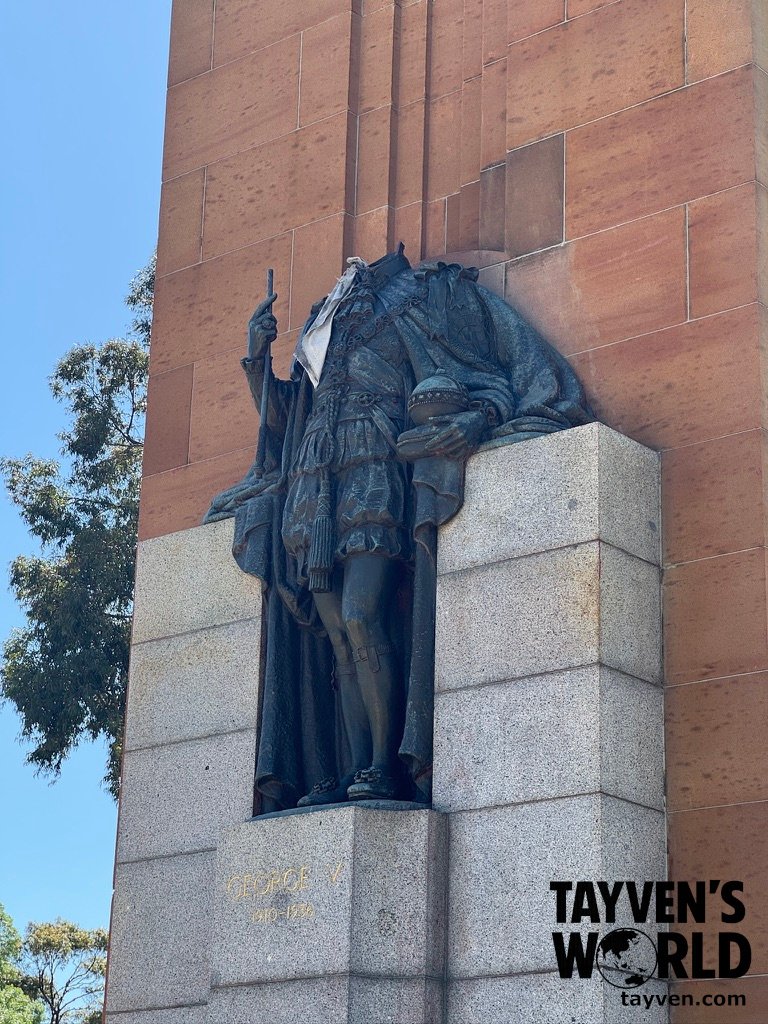
Earlier in the year, I’d been given a stack of old Australian pennies from my Pop and spent quite a bit of time sorting through them. As a result, I’d become surprisingly accustomed to staring at King George V‘s head. So when I realised his Melbourne monument was along our walking route, I thought it would be interesting to finally see the statue. There was just one problem.
His head was missing.
The statue had been decapitated in King’s Domain in June 2024. Then, in March 2025, the missing head unexpectedly appeared onstage during a Melbourne concert by Northern Irish group Kneecap. So there I was, finally looking at the rest of the bloke from my pennies while the one bit I actually recognised was off enjoying live music. It definitely made it a memorable visit. I don’t think the local Council was very happy and there was a recent paywalled article saying repairs are planned.
The Shrine of Remembrance
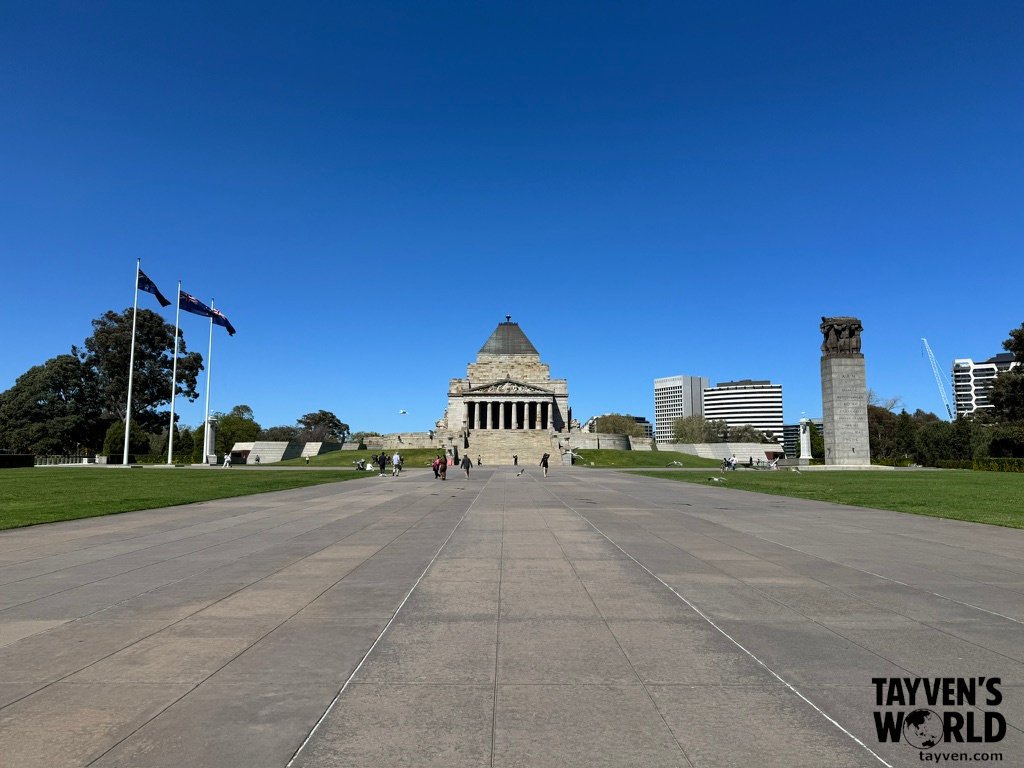
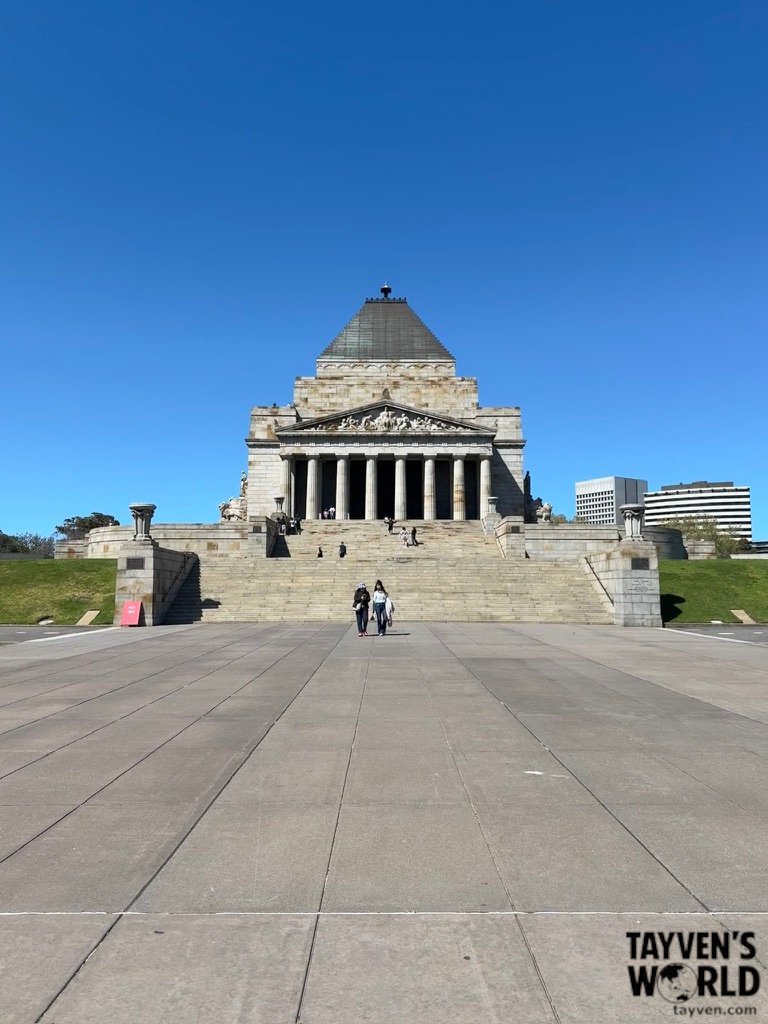
From there, the Shrine of Remembrance began dominating the view, growing increasingly impressive as we made our way through the parklands towards it.
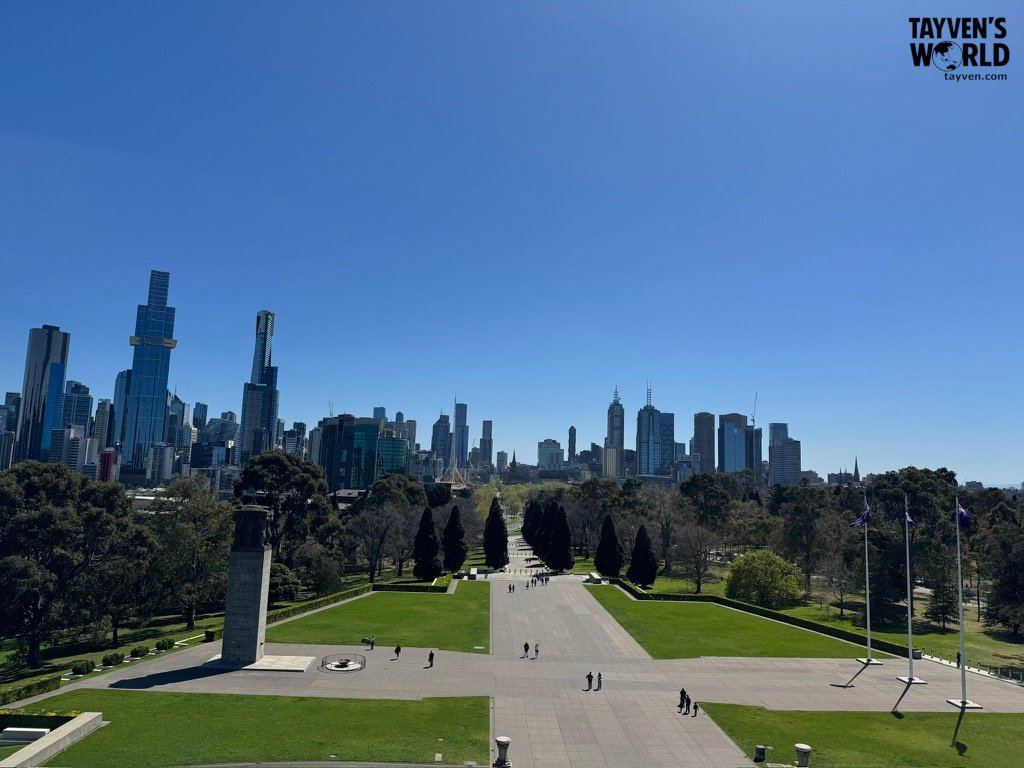
The Shrine is Victoria’s principal memorial honouring Australians who served and sacrificed in war and peacekeeping, combining the memorial itself with exhibitions, gardens and commemorative spaces. Its scale doesn’t really become apparent until you approach it on foot. Once we reached the broad steps and turned back towards Melbourne, the parklands opened out towards the city behind us. But the Shrine isn’t somewhere I’d visit purely for the view. Once we stepped inside, the atmosphere naturally changed.
Inside the Shrine
The interior is quiet and reflective.
Flags, memorials and exhibitions help tell the stories of Australians who served, while the enormous stone architecture gives the building a real sense of weight and permanence. Beneath the monument, the Galleries of Remembrance contain more than 800 artworks, historical objects, photographs, films and multimedia displays telling stories spanning more than a century of Australian wartime experiences.
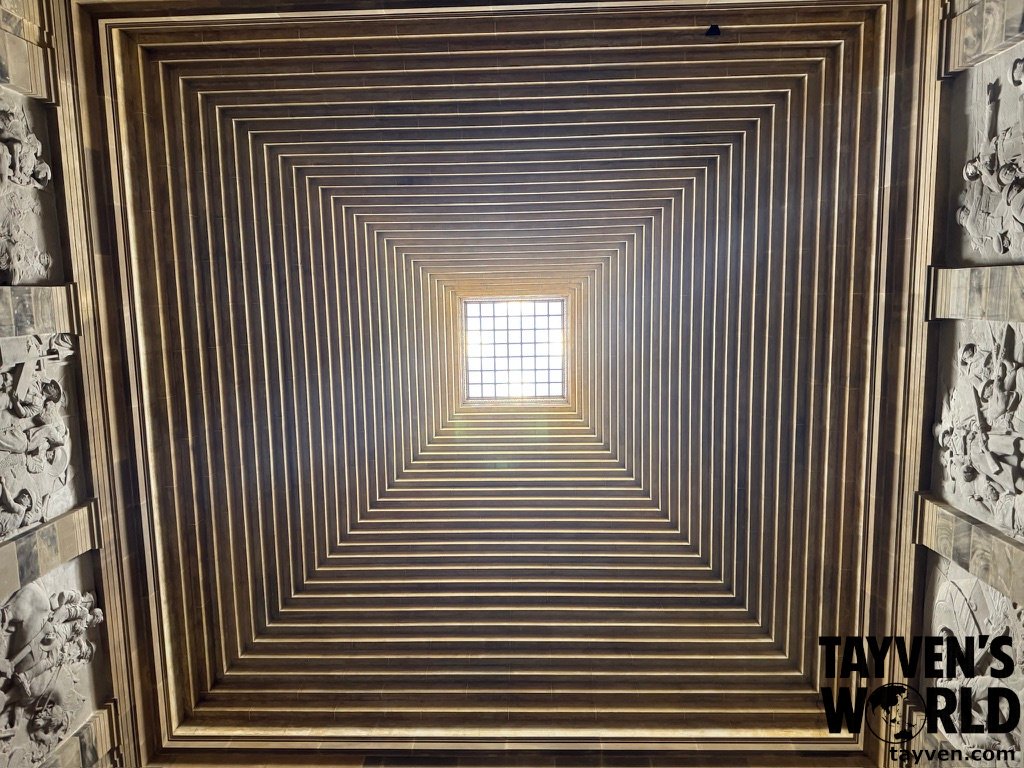
One of the things that struck me most, though, was the way light worked inside the building. As we moved through the upper levels, light streamed down from above, filling parts of the stone interior with a warm golden glow. Against all that heavy stone and monumental architecture, the light completely changed the atmosphere. It was a beautiful piece of design and one of those architectural details I appreciated far more than I expected to.
From there, we continued upwards towards the balcony. Apparently, after spending weeks climbing cathedral domes, observation decks and towers throughout Europe, we still hadn’t reached our family staircase quota.
Fortunately, once again, the climb was worth it. From the balcony, Melbourne stretched across the horizon beyond the parklands, while looking back across the building gave us a completely different appreciation for the scale and symmetry of the Shrine. The official visitor information describes the balcony as offering panoramic views of the surrounding gardens and Melbourne skyline.
We could easily have spent much longer exploring everything inside. If you want to properly explore the Galleries of Remembrance, the Shrine recommends allowing at least 1.5 hours. For our day, though, we were happy to experience the memorial, wander through some of the exhibitions, spend some quiet time inside and then continue exploring Melbourne. We weren’t trying to complete every attraction at 100 percent.
And because general entry to the Shrine is free, it’s very easy to include in a Melbourne walking day.
From Quiet Reflection to City Chaos
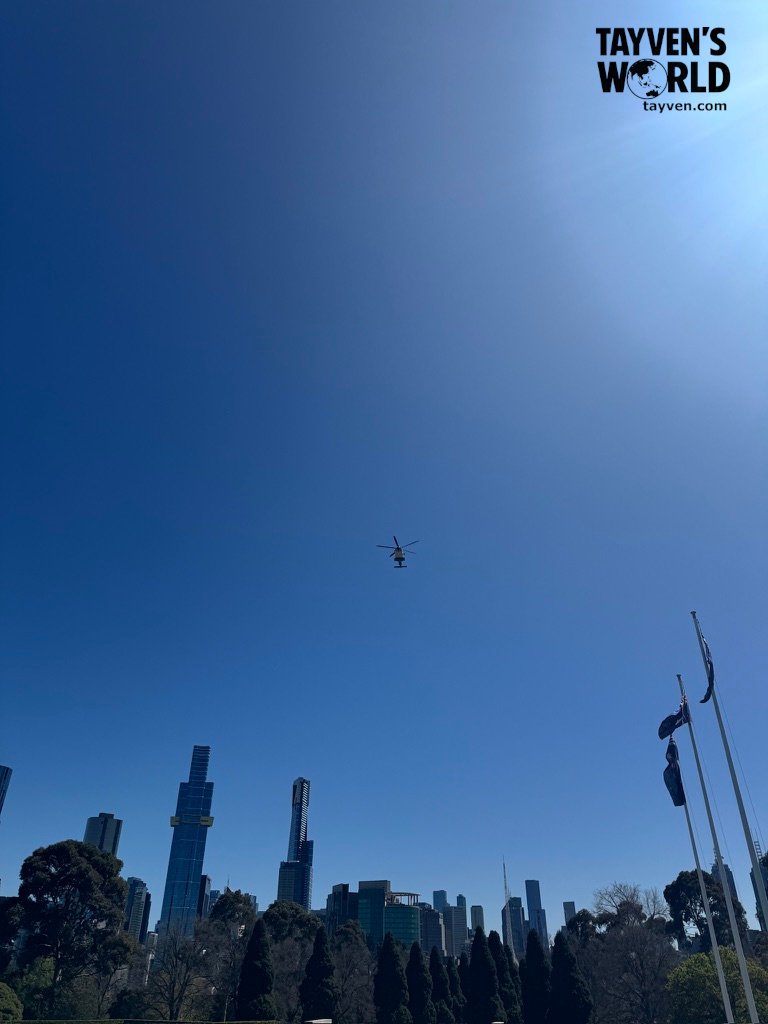
When we stepped back outside, Melbourne changed gears remarkably quickly. The peaceful parklands we’d just been wandering through were suddenly considerably less peaceful. A large protest was gathering along the road outside, accompanied by a substantial police presence and helicopters circling overhead. A family sightseeing day didn’t really require us to wander into the middle of a large demonstration, so we made a fairly enthusiastic beeline in another direction and watched everything unfold from a much more comfortable distance.
It was one of those unpredictable city moments you could never really plan. One minute we were standing quietly inside one of Melbourne’s most significant memorials, surrounded by stone, flags and golden light. The next we were adjusting our walking route because police helicopters were circling overhead. That definitely hadn’t been on my admittedly vague itinerary.
Onwards to Eureka
By this point it was only around lunchtime, and somehow we’d already packed quite a lot into the morning. We’d eaten a massive breakfast squeezed into one of Melbourne’s famous laneways, met under the clocks, crossed the Yarra, wandered through King’s Domain, found a king who had temporarily misplaced his head, and explored one of Melbourne’s most significant memorials. Not a bad start to the day.
But Melbourne wasn’t finished with us yet. Our next destination was waiting back towards the city skyline.
Eureka Tower.
FAQ
What does “meet me under the clocks” mean in Melbourne?
The clocks above Flinders Street Station have served as a traditional meeting point for generations of Melburnians. “Meet me under the clocks” became part of Melbourne’s language and remains associated with the row of clocks above the station entrance.
Is Flinders Street Station worth seeing if you’re not catching a train?
Yes. We weren’t catching a train at all and still made it part of our walking day. The historic façade, famous clocks and location opposite Federation Square make Flinders Street Station a Melbourne landmark in its own right.
How old is Flinders Street Station?
Railway operations on the site date to 1854, when Australia’s first steam-hauled passenger railway operated between Melbourne and Sandridge, now Port Melbourne. The grand station building seen today was completed in 1910.
Can you walk from Flinders Street Station to the Shrine of Remembrance?
Yes. The Shrine of Remembrance is 1.3 kilometres from Flinders Street Station. You can walk from the city or use public transport.
For us, walking was part of the experience because it allowed us to cross Princes Bridge and explore the parklands along the way.
Is the Shrine of Remembrance free?
Yes. General admission to the Shrine of Remembrance is free and no ticket or booking is required. Donations are welcomed.
How long should you spend at the Shrine of Remembrance?
You can appreciate the architecture, memorial spaces and city views during a shorter visit. If you’d like to explore the Galleries of Remembrance properly, the Shrine recommends allowing at least 1.5 hours.
Can you go to the top of the Shrine of Remembrance?
Visitors can access the balcony, which offers panoramic views across the surrounding gardens and Melbourne skyline.
Is the Shrine of Remembrance worth visiting?
For us, absolutely. The history is important, but I was also impressed by the architecture, the golden natural light inside and the unexpected views across Melbourne.
Can you combine Degraves Street, Flinders Street Station and the Shrine in one morning?
We did, and it worked very well for us. Breakfast around Degraves Street and Centre Place, photos beneath the clocks, Federation Square, Princes Bridge and a walk through the parklands to the Shrine of Remembrance created a varied morning without needing to rely on transport.
More Travel. Melbourne, Paris, London & Europe Travel Articles
Australia
Melbourne series:
- Melbourne Australia: City Streets, Fitzroy Gardens & St Patrick’s Cathedral
- Brighton Bathing Boxes to St Kilda: Melbourne Bayside Walk Guide
Blue Mountains Series:
- Blue Mountains 4‑Day Guide: Echo Point, Scenic World, Leura & Wentworth Falls
- Blue Mountains: A Winter Trip Through Memory, Mountains, and Family
Germany
- Berlin Germany: From Munich by Train to Our First Day in Berlin
- Munich Germany: Beer Halls, Old Town Streets, and a Birthday Across Borders
- Berlin: Checkpoint Charlie, Brandenburg Gate, and the Tiergarten
- Berlin to Amsterdam: The Day Everything Went Wrong (and Somehow Still Worked Out)
Switzerland Series:
- Bern Switzerland: A Small City Built for Big Moments
- Paris to Bern: A First‑Class Train Ride and a Complete Eurail Guide
- Lucerne Switzerland: A Day Trip That Felt Like a Postcard Come to Life
- Switzerland: Exploring Jungfraujoch, the Top of Europe
Paris Series:
- London to Paris on the Eurostar: A First‑Timer’s Story & Complete Guide
- A Rainy Start, a Seine River Cruise, and Paris Finally Opening Up
- Versailles, Paris Streets & The Unexpected Magic of a Laundromat
- From the Louvre to the Eiffel Tower: A Storm‑Soaked Day in Paris
- The Best 4 Day Paris Itinerary (Built From Real Experience, Not Brochure Fantasy)
London Series:
- Our Real 5‑Day London Itinerary: What We Planned vs What Actually Happened
- St Paul’s Cathedral London: History, Blitz Survival, Tickets, Tube Guide & Our First-Day Experience
- Westminster Abbey: A First‑Timer’s Guide (Tickets, Tips & What to Expect)
- British Museum First‑Time Guide: A Morning in Bloomsbury
- London Eye: A First‑Time Visitor’s Experience Above the Thames
- Battersea Power Station: From Industrial Giant to London’s Newest Urban Playground
- A Perfect Day in South Kensington: Museums, Parks & Retro Gaming Nostalgia
- River Cruise Along the Thames: From Buckingham Palace Mornings to Bloomsbury Nights
- Our Final Day in London: Royal Dawn, Parliament Secrets, West End Magic, and the Feeling of Not Wanting to Leave
Amsterdam Series: