We hadn’t planned anything for our first day in London. After a 24‑hour flight from Australia, our only mission was simple: stay awake until 8pm so we didn’t ruin the rest of the trip. With hours to fill before check‑in and no real plan, we looked at each other, shrugged, and said, “Let’s go see St Paul’s Cathedral.”
It turned out to be the perfect first London adventure.
A Brief History of St Paul’s Cathedral
St Paul’s Cathedral stands on Ludgate Hill, the highest point in the City of London, and has been a place of worship since AD 604. The current cathedral is the fifth to occupy this site. Its predecessor, Old St Paul’s, was destroyed in the Great Fire of London in 1666.
The present cathedral was designed by Sir Christopher Wren, with construction taking place between 1675 and 1710. Today, it remains one of London’s most recognisable landmarks, famous for its English Baroque architecture, its vast interior, and its iconic dome, one of the largest in the world.
For official visitor information, see the St Paul’s Cathedral website.
How St Paul’s Cathedral Survived the Blitz
During the Blitz of World War II, St Paul’s Cathedral became a symbol of British resilience. While London burned night after night, the cathedral remained standing, thanks largely to volunteer fire watchers who patrolled the roof and dome, extinguishing incendiary bombs before they could ignite the timber structure.
Winston Churchill understood the cathedral’s importance to national morale. He issued a clear order: St Paul’s “must be saved at all costs.” After major raids, he received updates on its condition, knowing that if the cathedral fell, the country’s morale would fall with it.
For more historical detail, see HistoryExtra’s article on St Paul’s in the Blitz.
Our Walk From Bloomsbury to St Paul’s Cathedral
We stepped out of our Bloomsbury hotel and straight into the weekday rush. Russell Square was buzzing, but all of that faded for a second because we’d just spotted our first red double‑decker rolling past, the kind of moment that makes you feel like you’ve properly arrived in London.
Following Gray’s Inn Road, we dodged umbrellas, grabbed a quick photo with a proper red letter box, and wandered past a timber‑framed café that looked like it had been dropped in from a medieval village.
As we continued toward the financial district, the buildings grew taller. We took a right near the London Stock Exchange, suddenly surrounded by banking professionals in sharp suits, then turned left at Temple Bar London, the old gateway that once marked the boundary of the City.
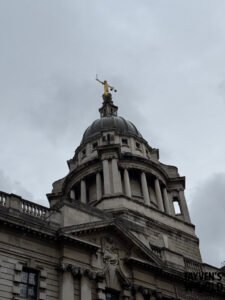
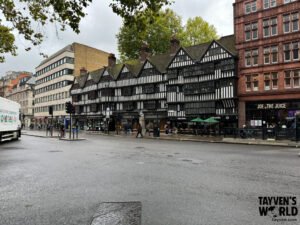
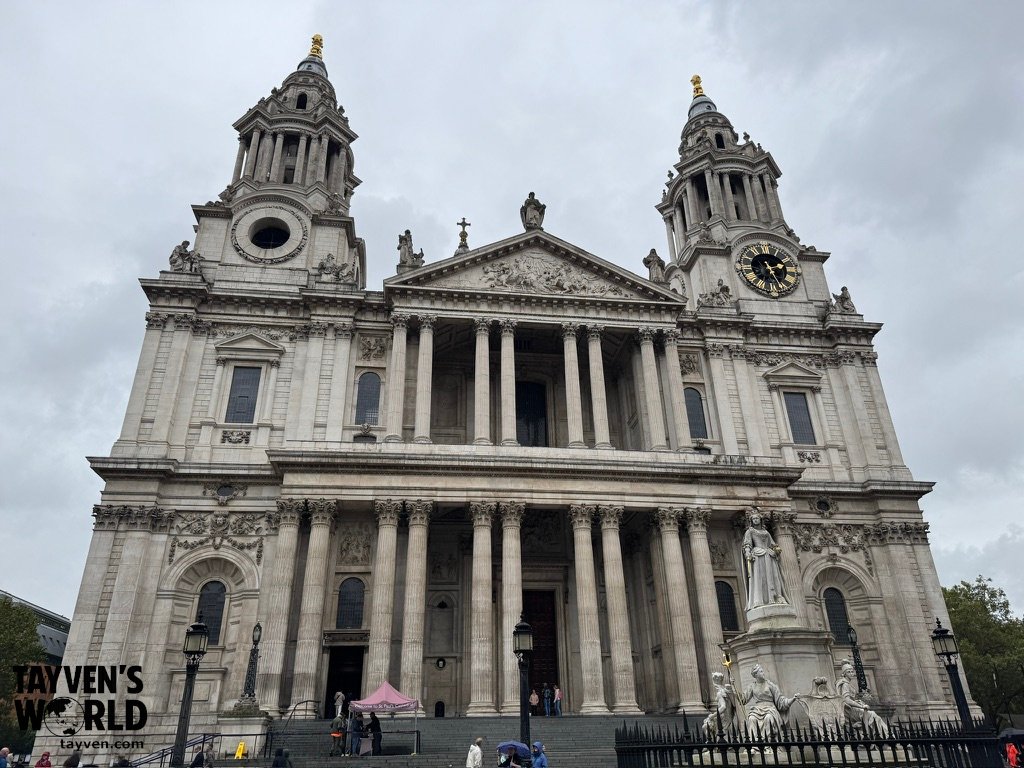
And then it happened, you turn the corner and St Paul’s Cathedral just appears, suddenly and completely dominating the street.
The Downpour
Halfway through the walk, the sky opened. Not a drizzle, a full, sideways, soaking London downpour. We had umbrellas and Kathmandu jackets, but it didn’t matter. Within minutes we were drenched.
Then came the moment that still makes me laugh: the sole of my “waterproof” boot peeled off completely. London: 1. My footwear: 0.
By the time we reached the cathedral steps, we looked like we’d swum the Thames to get there.
Entering St Paul’s Cathedral
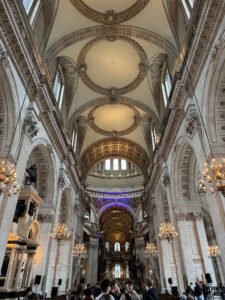
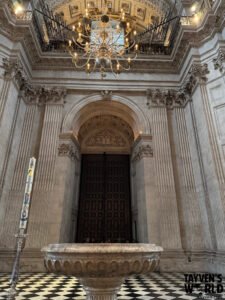
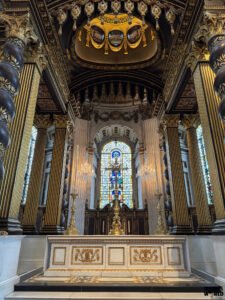
Before you even step inside, St Paul’s makes you feel small. You climb the grand front steps with the noise of the City buzzing behind you, and at the top a massive wooden doorway towers over you.
The moment you cross the threshold, the world just changes. The city noise disappears and everything suddenly feels still.
And then you look up.
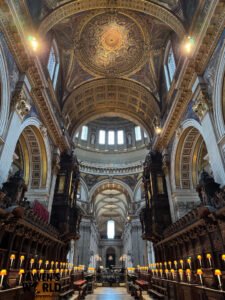
The ceiling rises impossibly high. Even exhausted, soaked, and carrying the emotional weight of a broken boot, we still stopped and stared up at it.
Climbing the Dome: Stairs, Galleries & Views
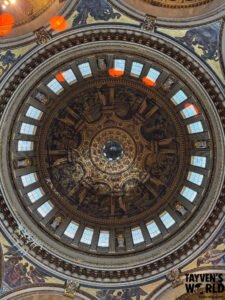
To reach the dome galleries, you climb hundreds of steps through a series of increasingly narrow and steep staircases. After walking across half of London in the rain, this climb was a serious workout.
Inside the dome, curved internal balconies offer views down into the cathedral. Small corridors branch off in every direction, stone tunnels, tight turns, and little doorways that make you feel like you’re exploring the hidden skeleton of the building.
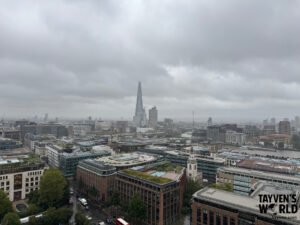
Higher up, the Stone Gallery and Golden Gallery offer sweeping views of London. Even through the mist, we spotted The Shard rising in the distance.
The Crypt: Who Is Buried at St Paul’s Cathedral?
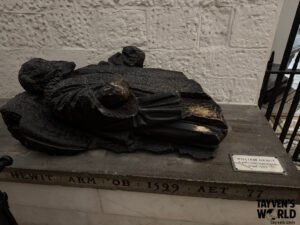
The crypt at St Paul’s Cathedral is the resting place of some of Britain’s most influential figures:
- Florence Nightingale: founder of modern nursing
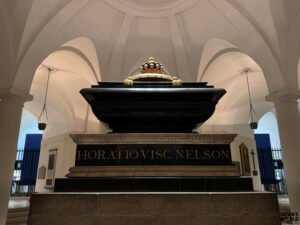
- Admiral Lord Nelson: the Battle of Trafalgar
- Duke of Wellington: defeated Napoleon at Waterloo
- J.M.W. Turner: one of Britain’s greatest painters
- Alexander Fleming: discovered penicillin
- Sir Christopher Wren: architect of St Paul’s Cathedral
These individuals are buried here because St Paul’s is more than a cathedral. It is a national monument honouring people who shaped Britain’s military, scientific, artistic, and architectural history.


St Paul’s Cathedral Gift Shop
Like many major attractions, you exit through the gift shop but St Paul’s has a surprisingly thoughtful one. Books, prints, ornaments, stationery, miniature domes, and religious items fill the shelves.
We bought cross necklace pendants for ourselves and a few for family back home. Mine now sits on my desk with my other travel memorabilia. On long workdays, I catch myself looking at it and, just for a moment, I’m back in London under that enormous dome.
How to Visit St Paul’s Cathedral: Practical Information
Location
St Paul’s Cathedral, Ludgate Hill, City of London
Closest Tube Stations
- St Paul’s: Central Line
- Mansion House: District & Circle Lines
- Blackfriars: District & Circle Lines, National Rail
- Bank: Central, Northern, Waterloo & City, DLR
For transport planning, see Transport for London’s Journey Planner. I also highly recommend the TFL Go App.
St Paul’s Cathedral Ticket Prices
(as of time of writing April 2026)
- Adults: £27
- Concessions: £24
- Children (6–17): £10.50
Tickets include access to the cathedral floor, crypt, dome galleries, and multimedia guide. Bookings can be made at the official St Paul’s Cathedral ticket page.
Continue Your London Journey
To see how St Paul’s fits into our full London adventure, read our main guide: Our 5‑Day London Itinerary
More London & Europe Travel Articles
London Series:
- Our Real 5‑Day London Itinerary: What We Planned vs What Actually Happened
- Westminster Abbey: A First‑Timer’s Guide (Tickets, Tips & What to Expect)
- British Museum First‑Time Guide: A Morning in Bloomsbury
- London Eye: A First‑Time Visitor’s Experience Above the Thames
- Battersea Power Station: From Industrial Giant to London’s Newest Urban Playground
- A Perfect Day in South Kensington: Museums, Parks & Retro Gaming Nostalgia
- River Cruise Along the Thames: From Buckingham Palace Mornings to Bloomsbury Nights
- Our Final Day in London: Royal Dawn, Parliament Secrets, West End Magic, and the Feeling of Not Wanting to Leave
Paris Series:
- London to Paris on the Eurostar: A First‑Timer’s Story & Complete Guide
- Paris Day 2: A Rainy Start, a Seine River Cruise, and Paris Finally Opening Up
Europe Series:
- Berlin: Checkpoint Charlie, Brandenburg Gate, and the Tiergarten
- Switzerland: Exploring Jungfraujoch, the Top of Europe
- Amsterdam: Canals, Culture and the Sweetest Stroopwafel of My Life
- Berlin to Amsterdam: The Day Everything Went Wrong (and Somehow Still Worked Out)